Showing posts with label parekowhai. Show all posts

Wednesday, September 14, 2016

The ups and downs of Michael Parekowhai

September has sure been an up and down month for Michael Parekowhai in Auckland. Out at the end of Queens Wharf, the plastic-sheathed form of his house is swarming with builders busy on what must be the biggest public sculpture in the country. And then across the street in Britomart, Parekowhai’s installation The Story of a New Zealand Forest is being taken down in preparation for major rail redevelopment. Public sculpture, can’t live with it, can’t live without it.

Images: top, installation of Michael Parekowhai’s public sculpture on Queens Wharf and bottom, The story of a New Zealand Forest before and after

Monday, August 08, 2016

The cat rabbit problem

It’s been a long haul but the 2016 OTN International Lookalike Challenge (OTNILC2016) has a winner. Finalists from the thousands of entries were preselected by a panel earlier this year and the winner was announced by our international judge at a small breakfast meeting on Friday 5 August 2016. The Tenth OTN International Lookalike Challenge winner is Mark Leckey with his Parekowhai lookalike Inflatable Felix. Mr Leckey is a British-born artist who works with collage, music and video. He made his first work using an image of Felix the cat in 2007. As has become traditional with the OTNILC2016, no prizes will be awarded.

Images: top, OTNILC2016 winner Mark Leckey's Inflatable Felix (2014) and bottom, Michael Parekowhai Jim McMurtry (2004)

Tuesday, July 26, 2016

Broken news

The New Zealand Herald, big time supporters of the arts (#kidding), couldn’t resist showing a stealth photograph of Michael Parekowhai’s sculpture Lighthouse in mid-construction. Kind of inconsistent for a newspaper that will put out a spoiler alert for discussion of an episode of Game of Thrones. Of course the NZH had its view of the work sorted out long ago.  So not surprising this latest story notes that, ‘it has been labeled a monstrosity and joke by some members of the public’ but forgets to mention that (spoiler alert) nearly one hundred percent of the outrage was via the comments sections to its own stories. It's not called the ‘news cycle’ for nothing.

Image: Michael Parekowhai sculpture under construction. Photo: New Zealand Herald, pixelation OTN

Tuesday, May 17, 2016

12 cool things Kiwi (visual) artists have achieved in the past year

The other day a headline in the NZ Herald caught the attention: '12 cool things artists have achieved this year'. Of course when you clicked through the artists involved were musicians and not of the installation, photographic, painting or sculpture variety. So here’s a 12 cool things they have achieved in the past year.
 

Billy Apple at 80 finally got his long overdue survey show at the Auckland Art Gallery. Did that mean he'd then sit back and take it easy? Not a chance. Apple is always ticking off items on a list of shows and projects that stretches into the future as well as getting to most of the key art events in the city.
 

Ruth Buchanan turned artist/ curator in Berlin with a series of thoughtful and witty interventions into a private collection being exhibited at the Hamburger Bahnhof. In the overall project A-Z The Marzona Collection Buchanan made changes and additions to the sections J, L and K in the alphabet-based show.

Simon Denny has to be included. He had a very good year but who’d have thought that MoMA, having purchased his sculptures last year, would make another large purchase from his Venice show.  As they say, the first purchase is representation, but if they come back for more, it’s serious attention.

Lisa Reihana proved that history can pull crowds with her large-scale video installation in Pursuit of Venus [infected] based on nineteenth century wallpaper. It got her the Venice gig, it's in contention for the Walters Prize and already some significant art museums have shelled out big bucks to buy their very own copy of the work.
 

Michael Parekowhai certainly kept his cool over the last 12 months. And that despite the politicians of Hamilton and some vociferous people in Auckland ranting on about how his public sculptures were a waste of money no matter who pays for them. They'll be the same people in a few years doting on their grandkids playing in the waterfall of the Hamilton one and looking through the windows in the Auckland one.

Judy Millar who somehow manages to live in Europe and New Zealand at the same time also seems to be able to work at both a major and intimate scale. Not only did she produce the huge architectural scale sculpture The Model World at Te Uru, she also managed to illustrated a kids' pop-up book of the same name.

Dick Frizzell continues to be the whirlwind of New Zealand art marketing. He's always there in some media release or other weighing in on a contentious issue, launching a product or gifting works to this charity or that. Is this cool? Maybe not exactly, but it is impressive.

Len Lye continues to be the only artist in NZ ever to reach out from beyond the grave and continue to ghostwrite new works via a ouija board of governors. If that’s not cool, nothing is.

Li-Ming Hu used DIY cut-out masks and Vimeo to shift a few boundaries and crack us up at the same time. Her take on the team who ran Gambia Castle was a knowing mix of hilarity and edge.
 

Francis Upritchard’s exhibition at Monash University (MUMA) in Australia was a remarkable survey of her work from art school days to the present. Some of the museum based work of the early 2000s looks as fresh as the day it was made (and the poster is beautiful too). The exhibition is now showing at the City Gallery in Wellington. And Auckland, will it be showing in Auckland where all the people are? Er, no.

Fiona Connor
has been based in LA for a while now and for the last year has been running her own apartment gallery featuring a strong showing of artists from New Zealand. Laurel Doody has now wound up its gallery phase but not before getting some serious critical attention in the city.

Luke Willis Thompson took a whole lot of people for a ride in New York City, well a walk in fact. His contribution to the New Museum’s 2015 Triennial was to invite visitors to step out into the city on a choreographed walk. Often unsettling, it continued Thompson’s investigation into cultural relationships, power and space.

Thursday, April 07, 2016

Intruder

Ok, no artist owns rabbits and none own huge inflatable sculptures or rabbits as metaphors for the invasion of an environment. But you have to admit if you put all three together the person who comes to mind in New Zealand and Australia is Michael Parekowhai. This pic of inflatable rabbits installed in San Francisco by Australian artist Amanda Parer certainly hits the same trifecta. Parer has been touring her rabbits round the world for the last couple of years following in the footsteps (ok wake) of Florentijn Hofman’s large rubber ducky. Parer's rabbit installation is called Intrude but maybe she might consider giving a little credit where credit is due and rename it Ghosts of Mike P.

Images: top, Amanda Parer’s Intrude
2012 currently installed in San Fransisco. Bottom left, Michael Parekowhai Cosmo Melbourne Art Fair 2006 and right, Jim McMurtry and Cosmo at the Queensland Art Gallery 2010. (Thanks for the point A)

Monday, March 07, 2016

Twins

When Michael Parekowhai decided to paint red the carved piano He Korero Purakau mo Te Awanui o Te Motu just days before it was to head off to the Venice Biennale, the paint job was a radical gesture. And even more radical given that the piano was black when it had been purchased by Te Papa. Now that's a vote of confidence in an artist. Now an OTN reader has just sent us a pic that shows that there’s not one but two red pianos in Te Papa’s collection. One is the carved version by Parekowhai while the other is a baby grand (literally). It was made in the UK in the fifties by O & M Kleeman under the brand Kleeware. Unlike the Steinway modified by Parekowhai, this tiny grand is just 3cm high designed, as it was, to furnish a doll’s house.

Images: left, Kleeware and right, Michael Parekowhai’s He Korero Purakau mo Te Awanui o Te Motu: story of a New Zealand river, both collection Te Papa Tongarewa. Thanks A

Tuesday, September 29, 2015

Light touch

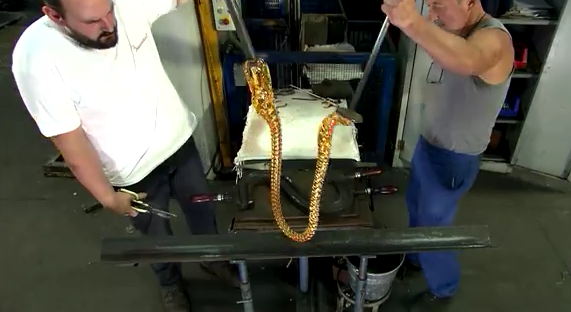
Now that Michael Parekowhai’s Lighthouse sculpture featuring a super-sized chandelier is all go, you might be interested to check out this video of a couple of guys actually making one. Just how the Parekowhai version is going to look is still obviously in the planning stages although there are hints that it will include NZ imagery. Looking at the skills required, getting something like this made in New Zealand is going to be a challenge. Still we are talking about a guy who had a full-sized bronze elephant cast in Henderson so there you go.

Monday, June 15, 2015

Smoke and mirrors

The mainstream media has never had such a positive relationship with art, and contemporary art in particular, but last week the Waikato Times made a grab for the golden ring. 'Another slow news day, let's ramp up that Parekowhai thing again. 
 

And so the headline ‘Calls for city council to rethink Parekowhai sculpture’. But it turns out it was not 'calls' so much as a couple of private conversations, an ex Mayor chatting to some old mates on council. Even she admitted that she'd only 'raised these concerns behind the scenes …' and, backing down somewhat, was 'simply passing on comments that had been made…' Turns out that she’s not even opposed to the sculpture personally ('I think it's quite jolly'), just to where it's to be sited ('It’s such a huge big thing').

Then the Waikato Times promises 'A stoush is brewing among the city arty types' but again they're just blowing smoke. A stoush, for all of you who love dictionary definitions, is a fight or a brawl. So you have to ask, as the Parekowhai sculpture has passed through all the Council processes, who is the Waikato Times suggesting is going to line up on the other side of their ‘stoush’?  Of course the ex Mayor also has some skin in the where-do-you-put-public-sculptures game. She's a member of a group that has just commissioned its own public sculpture a large (one-and-half times life size and sit on a two-metre high base) realist bronze statue of a war artist.  And what-do-you-know, it’s real close to where the larger, brighter, more commanding Parekowhai will be located.

So please, could you all move away, there’s nothing to see here, just 300 words trying to rekindle a fight probably in the faint hope it might give the Waikato Times a real story to report.

Thursday, May 14, 2015

A gift economy

The Government (from the Minister for Culture and Heritage down) has been strangely silent on one big issue: Auckland’s bizarre late-in-the-day public consultation process on the Michael Parekowhai's Queens wharf sculpture. Strangely silent because if there's one thing this Government (which seems to import all its cultural policy ideas direct from the UK) has been pushing over the last few years, it's shifting arts funding from the public sector over to private patronage. And yes it's exactly the kind of patronage demonstrated by the real estate company Barfoot and Thompson with the Parekowhai project. By now they must be wondering why they even bothered to make their million-dollar offer to the city. 

A million is a fair whack in the visual arts world. It’s about a quarter of what Creative NZ distributes to the visual arts sector every year and over three times what the Auckland Art Gallery gets annually for ‘collection development’ from the Auckland Council ($292,000 last year). 

We’ve mentioned before the lack of support for the Parekowhai project by the Auckland Art Gallery and art professionals in general, but why nothing from the Government? Even given the usual easy out for Ministers ‘we can’t be seen to interfere in local affairs' (until they do that is), the Parekowhai gift is surely something of a test case or, at the very least, an indicator of how their philanthropy thing is going to work out. Potential philanthropists can hardly fail to notice that Barfoot and Thompson have been hung out to dry. So will the rich quietly line up to twist-in-the-wind while the public takes pot-shots at their pet projects? Yeah, that sounds like fun.

Monday, March 30, 2015

Dancing

Most people from New Zealand and Australia will see that one of the key sources of Michael Parekowhai’s giant statue of James Cook, The English Channel, is a famous portrait by Nathaniel Dance. Joseph Banks commissioned the painting and Dance was given a couple of hours at Banks’s house to make some drawings of the man. The painting was made in May 1776, a few months before Cook sailed off to the Pacific for the last time. Parekowhai being Parekowhai, there are some personal layers to the work, including the revelation at the exhibition that Cook’s face is closely based on that of Parekowhai’s studio manager Ian Radford. Radford, like Cook, is an Englishman from the North, in his case from Manchester.

Many statues have been based on the Dance painting. It was regarded at the time as a good likeness of the famous Captain and most representations show him as a man of action. Parekowhai’s Cook, though, is more pensive and less certain of the path he has taken. This is not the first major sculpture Parekowhai has based on an existing painting. The indefinite article was inspired by Colin McCahon’s I Am (1954). Then, Parekowhai’s challenge was to New Zealand’s most important painter, but The English Channel seems more a meditation on what it might mean to dematerialize the man who kickstarted New Zealand’s British occupation.

One thing the English channel and its house totally demonstrates is that the lighthouse work proposed for Auckland's Queens wharf will not only be successful as an installation but also, looking at the first days visitors to The Promised Land, incredibly popular.

Images: top, Ian Radford with with Michael Parekowhai's The English Channel and bottom Cooks around the world

Friday, March 27, 2015

Show and tell

The survey exhibition that curator Maud Page and Michael Parekowhai have put together in Brisbane is extraordinary. And that’s just from a quick look during the last minute rush to get finished for the opening tonight. The space GOMA has dedicated to the show is immense. Parekowhai has got to be one of the few New Zealand (or Australian) artists who could manage both the scale and the volume of these cavernous spaces. He’s done it by carving out three large areas. The opening space is dominated by a full-scale, two-storey house (the original can be seen in Sandringham, Auckland) that shows off the most recent work in the exhibition - an oversized, stainless steel sculpture of Captain James Cook. Loosely based on the famous Nathaniel Dance painting, it traces a full circle for Parekowhai back to one of his first works, The Indefinite Article, which was a 3D version of Colin McCahon’s 1954 painting I am. The middle section of GOMA is marked off by a massive version of the Cuisenaire wall that featured in The far side exhibition at Michael Lett in 2011. Behind the wall is an idiosyncratic survey of Parekowhai’s work mixing up work from different periods in a series of domestically-sized rooms. And then it’s into a huge, almost empty space with the carved red piano He Korero Purakau mo Te Awanui o Te Motu: Story of a New Zealand river and an elaborate neon sign. We’ll be at the opening tonight and will post photos on Twitter and Facebook as soon as we can.

Image: catalogue for the exhibition Michael Parekowhai: The Promised Land at the Gallery of Modern Art at the Queensland Art Gallery and The English Channel a stainless steel sculpture of Captain Cook.

Monday, March 16, 2015

Somewhere over the rainbow

What’s going on with the Auckland Art Gallery and Michael Parekowhai? It's not about the collections. The AAG has 10 works in the collection and another 13 on loan from Chartwell and it usually includes his work in its permanent collection display (you would, wouldn’t you #popularwiththepublic) but for some reason the Gallery seems to struggle in its relationship with this significant, Auckland-based artist. Some examples:

Thanks but no thanks
   On 27 March the largest exhibition so far of Michael Parekowhai’s work will open to the public. It's a major survey with both new and earlier works putting the artist into perspective.  The weird thing? The Promised Land will open in Brisbane at the Queensland Art Gallery. Will it come to New Zealand or more specifically to the Auckland Art Gallery? No plans at this point. How is this even possible?

Full on Fiona Foley fury   In April last year the Auckland Art Gallery invited Australian indigenous artist Fiona Foley to speak at a symposium. The topic? The changing thinking around Māori art today. Known here for her very public (and well publicised) opposition to a large public commission Michael Parekowhai was given in Queensland, you might expect Parekowhai would have been invited. He wasn’t. And Foley, the only non-Maori of the five participants on her panel, predictably used the event to accuse Parekowhai of cultural theft.

No play  In 2011 Michael Parekowhai was NZ's representative at the Venice Biennale. It was there he exhibited the red carved piano He Korero Purakau mo Te Awanui o Te Motu: story of a New Zealand river. It was purchased by Te Papa immediately and since then it has been on loan to NZ galleries and museums around the country. At the Christchurch Art Gallery, for example, large crowds came to a temporary venue in the city to hear it played. Its first showing in an Auckland public art institution was at Te Uru in Titirangi. It has never made it through the doors of the AAG.

The sorry State of things   August last year the NZ Herald gleefully went into art bashing mode when it got hold of leaked sketches for a proposed Parekowhai sculpture on Queen’s wharf in Auckland. It did tend to hide behind 'our' correspondents with headlines like Readers up in arms over "offensive, stupid" state house sculpture, etc but it kept the brouhaha going for a week or two. It was left to art patron Jenny Gibbs and Metro’s Anthony Byrt to wade in publicly (Why Michael Parekowhai’s State House Sculpture is Worth Celebrating) in defence of the work. The Auckland Art Gallery? Not a peep.

Rhana Devenport will be at Parekowhai's Brisbane opening later this month, presumably with some of her senior Auckland Art Gallery staff. Let's hope that at the top of her agenda is sorting out with Chris Saines, Director of the Queensland Art Gallery, what's required for a bringing The Promised Land home.

Wednesday, March 11, 2015

Spare the rod

Most art copycats attempt to slip under the that’s-not-your-idea-stop-it-or-pay-for-it wall and hope that their copy will be mistaken for a ‘version’, or even better a clever twist, on the original. That’s not for Jan of Otago whose house is featured in the latest Resene magazine, Habitat. 'Colour loving' Jan woke up one day to the realization that her house was 'not her’. What to do? What Jan did was to let her daughter Fiona have a go at brightening up the bathroom. The result? A triumph of 'unexpected colours”. Well unexpected if you haven’t seen one of Michael Parekowhai’s Cuisenaire sculptures that is. Checking out the art on other walls of Jan's house that seems kind of unlikely.
 

Ok, as someone once said, imitation is the sincerest form of flattery and would you believe it that someone was a famous eighteenth century art collector Charles Caleb Colton. But there’s copying and copying. Right? Interestingly enough, Cuisenaire rods themseves are part of a case that is often quoted in copyright case law when trying to decide what is and what isn’t able to be copyrighted as art. In 1963 an Australian case, Cuisenaire vs Reed, decided that the main object of production had to be creating something that even if it was utilitarian was basically designed to appeal to the aesthetic tastes of the people who look at it. We’re drifting here. Should Jan send a cheque to MP for artistic services rendered? Probably. Flowers, chocolate, and champagne? Definitely. 
 
Images: top Michael Parekowhai's work The Far Side at Michael Lett and bottom Jan and Fiona brighten up the bathroom

Friday, March 06, 2015

.


First up: to hell with ‘Five things for Friday’  We did say we'd try it out and we did and we don’t like it and reading through the piles of mail that have come since starting it, one of you doesn't like it either. So here’s what we’re going to do. Once a week, probably Monday, we'll do a longer piece and for the rest of the week post stuff as it comes. If there’s nothing there’s nothing if there’s lots there's… you get the idea. If we see it and think it’s interesting we’ll put it up on OTN and let you know about it via FB and Twitter. So good luck with that.

Heirs   Most visitors to the McCahon House in Titirangi (you should go if you haven’t, it’s kind of amazing) come away with the same story, ‘Did you see that room where the McCahon kids had to sleep under the house?’ The three-walled bays with bunks for the kids to sleep in were constructed under the house in the mid-1950s although they also had their own separate bedroom from around 1958. The bunkroom with one wall open to the elements and bugs may feel harsh today but anyone who grew up in the fifties will know about parents obsessing over fresh air. ‘Go outside and play’ was the mantra (some personal bitterness creeping in here, perhaps?). From the forties government Health Camps were scattered around the county all designed to fill little lungs with life affirming oxygen. It was a thing of the times and as the McCahon bunkroom was probably only used over summer (and just for a couple of years) it was maybe not so harsh after all. After all, in places like Stockholm, parents leave their babies outside in their prams in -5C (23F) temperatures. Harden up NZ. 

The Doctor will paint you in a moment “The professionalization of art production – congruent with specialization in other postcapitalist industries – has meant that the only art that will ever reach the market now is art that’s produced by graduates of art schools.”  Chris Kraus in Akademie X: Lessons in Art + Life.
Discuss.


Dream job   Ambitious curators in New Zealand will be all aflutter with the news that Juliana Engberg has resigned as the Artistic Director at ACCA in Melbourne. She is off to Denmark after 13 years in the famous rust-coloured building.  Engberg has been a good friend to New Zealand artists over the years although, curiously, picked just one, Shannon Te Ao, for her 2014 Sydney Biennale. ACCA is a big prize for any curator with Engberg leaving behind a reputation for smart shows and attitude. While Melbourne’s not an easy ride for outsiders (as Rodney Wilson found out when he did his year as Director of the National Gallery of Victoria in 1988) it would definitely be worth a try and might look attractive to curators who have already worked in Australia.

Heads up    When we were in Brisbane last year we saw Michael Parekowhai’s sculpture As the world turns for the first time in its final location. The last time we'd seen it was as it was being craned up through the roof of the foundry in Auckland (it was too big to go through the door). The sculpture is of an elephant standing on its head so it was cute to see in one of the museum shops a shelf of toy animals which someone had playfully turned into a copy cat.

Monday, January 26, 2015

Auckland Museum and the vanishing of Michael Parekowhai

You'd think, wouldn’t you, that a museum by its nature would be kind of committed to the keeping of history thing. So what’s going on with the Auckland Museum and Michael Parekowhai? And why is the Museum trying to remove all traces of the exhibition Pare Kawakawa by Parekowhai from its website?

Let’s back up a bit. Early December last year the Auckland Museum announced 'a new exhibition from renowned New Zealand artist Michael Parekowhai.' It was to open this year on 17 April in the Sainsbury Horrocks Gallery as part of the much touted First World War Centenary Programme. According to the media release Parekowhai had already been working with the museum for about a year so the project was well advanced. Auckland University was behind it and Creative NZ had put in $174,000 into the project via the WW100 co-commissioning fund [link 3 December]. Pare Kawakawa by Parekowhai was also lined up for an international tour.

So why has the Auckland Museum suddenly decided to make this exhibition disappear? A quick search for it on the Museum's site brings up a series of ‘Page not found’. Page not found is like telling someone you can’t find the cat when you’ve just drowned it in a sack. What they really mean is ‘Page removed' which is quite a different thing. More disturbingly the media release circulated on 11 December 2014 has been removed from the Auckland Museum media archive (aka the historical record). But welcome to the internet - you can read it here or here.

For a century New Zealanders have struggled to deal with the trauma of our involvement in WWI. It has been distorted, idealized and manipulated. Ironic then that the same history-bending games are now being played out via the commemoration of that very event. In one final twist, the Auckland Museum theme for the year’s programme that included the proposed Parekowhai exhibition is ‘Death of Innocence’.
 

Images: top, now you see him. Bottom, now you don’t

Friday, September 26, 2014

cARTtoons

Michael Parekowhai's art continues to fascinate the cartoonists, this time Bromhead  with his Munch lookalike in the Herald today.

Thursday, August 28, 2014

cARToon

Here's a rule of thumb for assessing a work of art. Does it appeal to cartoonists? Guy Body’s drawing published in the NZ Herald the other day picks out some of the layers of meaning in Michael Parekowhai's Lighthouse for the Auckland waterfront and pulls it right into political commentary. Works that have featured in cartoons make a line-up of populist stars that don't even need the artist's name - Mona Lisa, The scream, Nude descending a staircase, American gothic, The Physical Impossibility of Death in the Mind of Someone Living (ok that one probably needs the word 'shark' and Damien Hirst's name attached). Cartoonists are often the first to grab on to powerful images that they can connect with current ideas. 

So here's a prediction. For all the fuss about, Parekowhai’s lighthouse it will become the background of countless selfies, a feature on all Auckland city tourist material and (like Neil Dawson’s Ferns in Wellington) quickly assimilated into the city landscape as a much loved icon of Auckland.

Friday, August 01, 2014

House rules

The NZ Herald - always keen to support Auckland's visual culture where it can - has set up a DIY sculpture competition. This is so Aucklanders can submit their own designs for something to replace the proposed Michael Parekowhai sculpture at the end of Queens wharf. It’s a tactic that the Herald might extend into other areas. What about ways the city might be policed or how to make particularly difficult brain operations easier or even some creative input into designing sewage systems for new housing developments? The NZ Herald is helping readers understand that most expertise is over rated and that practically any item of art purchased with public money is bound to be suspect. You can submit ideas for how the editorial policy of the NZ Herald could be transformed to make it a great daily newspaper here.

COMMENT: John Johnston 01-08-14 They must have controversy envy, after seeing the current Fairfax-spurred controversy about the Sydney public sculptures.

Tuesday, April 15, 2014

Stand in

The tie up with art and fashion has always interested OTN. In NZ you can trace it back at least to the late eighties. We still have a John Reynolds Amour windbreakers designed for Workshop around that time and more recently Max Gimblett and Martin Popperwell have also come on board. Now Michael Parekowhai has also jumped in to the fashion world. His work has been seen at Karen Walker’s North Shore store but this time he was collaborating with designer Tanya Carlson for her exhibition Not all white at the DPAG for ID Fashion week. Carlson was showing off 15 years of her work staged on Parekowhai Cuisenaire rod stands.

Monday, March 10, 2014

Transplant

There’s a long tradition of artists putting works in retail store windows. Famously Andy Warhol did it for Bonwit Teller in New York and now in Auckland you can see a primo example by Michael Parekowhai. 

Greg Ryder’s hair salon was previously in a building close by the university (Trish Clark has her eyes on it for a new dealer gallery we’re told) and he used to show a few works by Parekowhai there from time to time. Now Ryder's downtown salon has been turned into a full-on showcase. From a life-size bull in the reception area to five orchestrated window displays (plus a few other items to surprise you) there’s a lot to see when you get yourself down there. Ryder is on the corner opposite the bottom of Anzac Ave.