Showing posts with label collecting. Show all posts

Tuesday, September 13, 2016

No show

OK, so it wasn’t the most original idea in the world, but Te Papa always said it was going to tell us our stories, the stories of Our Place. It then went on to spend many millions of dollars in purchasing items that would help that story telling. Most recently there’s the $1.5 million it paid for View of Mt Egmont, Taranaki, New Zealand, taken from New Plymouth, with Maoris driving off settlers’ cattle painted in 1861 by William Strutt.  All this means that when Toss Woollaston’s painting Poet by the sea (1959) came to market in the Tim and Sherrah Francis auction, it seemed a natural fit for Te Papa.

The Poet by the sea is a knotted array of cultural aspirations. Its subject is Charles Brasch, acknowledged as the cultural big cheese of the 1950s (poet, friend, editor, collector, high-minded fan). The painter is Woollaston who at this time carried the burden of finding the soul of NZ. The collectors were Tim and Sherrah Francis who were committed to the importance of a distinctively NZ culture and history. And to cap it off, Peter Simpson’s recent book Bloomsbury South describes the story in detail (with photographs). It’s a heavy-duty painting showing real cultural dynamics at play. It could hardly be more central to the National Collection and the story of NZ art.

But as we all know, Te Papa didn’t even make an appearance at the auction and made not a single purchase. Te Papa didn’t lose out to some deep-pocketed Auckland art fanatic at the auction either; it simply decided that it wasn’t worth the effort. Something’s afoot, especially when you remember that Te Papa spent $700,000 at the Paris Family auction in 2012 and hasn’t been shy to spend big bucks. Let’s recall:

Colin McCahon, A painting for Uncle Frank, 1980, purchased in 2000 for $2 million
Colin McCahon, Walk (series C), 1973, purchased in 2004 for $2.75 million
John Webber, Poetua, 1785, purchased in 2010 for $1.97 million
Michael Parekowhai, He Korero Purakau mo Te Awanui o Te Motu: story of a New Zealand river, 2011, purchased in 2012 for $1.3 million

In the very active Te Papa rumor mill it’s claimed that the institution’s collecting policy for art is shifting. Buying back to fill out the collection is out. Buying forward to prioritise the contemporary is in.  Can this be true? The last four curatorial hires all specialise in earlier work. Smart move Te Papa. Crazy times ahead.

All this would certainly help to explain why Te Papa wasn’t at the Francis auction to pick up high quality works by both neglected and well-known artists. Our top ten of these would be:

Philip Trusstum Pale blue square $9,000
Douglas MacDairmid Portrait of Akbar Tyabi $6,250
M T Woollaston Poet by the sea (A Portrait of Charles Brasch) $80,000
Richard Killeen Rot $9,500
Ross Ritchie After Ingres $10,600
Adele Younghusband Still life with candle and vase of flowers $9,250
Charles Tole A map of the Auckland province $5,600
H Linley Richardson Self portrait $2,500
Robert Ellis City $4,000
Dennis Knight-Turner Untitled $9,000


Image: Poet by the sea (a portrait of Charles Brasch) in the Te Papa storage racks (#notgoingtohappen)

Tuesday, June 07, 2016

Rules of the game

Over the last two days in Berlin we’ve been to see two private collections and they could hardly have been more different. The current trend for super rich collectors to open their own art museums has exploded in Berlin as it has in most of the rich tip of the first world iceberg. We’ve posted before about Berlin's Boros and Haubok collections but now two newcomers have joined the game and they are something else again. 

First, the good news. The Julia Stoschek collection is based in Dusseldorf but has popped-up in Berlin for six months. It’s housed in a large central city building that looks like it was once some sort of radio or television studio and for this round it’s appropriately only showing media based work. Fifty percent of what’s on show is by women artists, most of it English-language based, entry is free and the work is shown in separate rooms with often more than one work by an artist. It’s a great way to see a lot of art beautifully installed with people who are as interested as you in the experience.

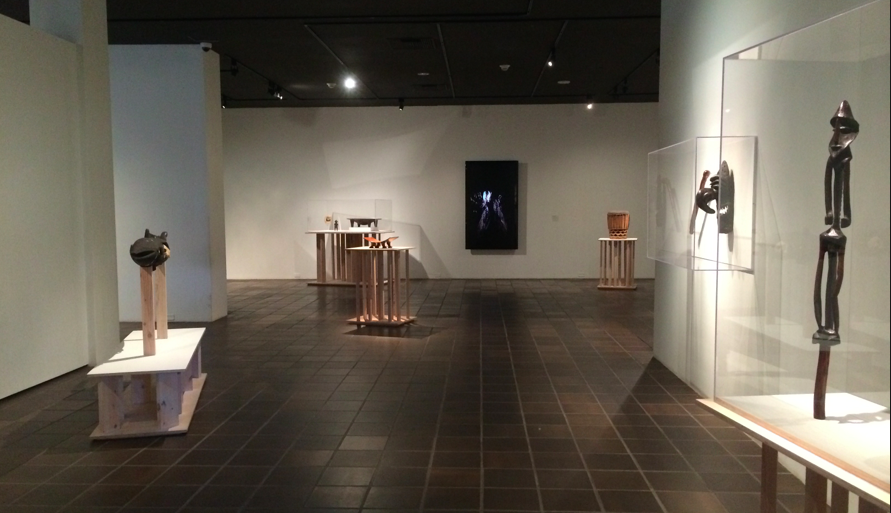
The just-opened Feuerle collection is at the other end of the spectrum. If the Julia Stoschek collection is sophisticated, confident and open-ended, the Feuerle is controlling, pretentious and somewhat vulgar. Désiré Feuerle has some very fixed ideas about how you should look at his art holdings. First the descent to the basement draped in a blanket (it’s cold down there). Then the pause in a pitch-black room to ‘meditate’ while listening to a two and a half minute piece by John Cage to get you in the right frame of mind. Only then are you are allowed to shuffle into the cavernous gallery space. It’s an ex World War II bunker renovated with a creepy amount of care by John Pawson. A sprinkle of plinths and display cases feature ancient stone and metallic sculptures from Southeast Asia. Spot-lit in the darkness, reflected and mirrored, it’s a spooky sight. While ‘heart of darkness’ may have been the leading edge style in the 1970s (think Treasures of Tutankhamun at the Metropolitan Museum in 1976), such radical decontextualisation and aestheticisation is now seldom seen in public museums. This is very much a private enterprise with precise rules of engagement and no information about the works at all.  Presumably to leaven this austerity some Nobuyoshi Araki photographs of bound naked women are also hung around the walls. What could possibly go wrong.

Images: top, contemporary media art on view in the Julia Stoschek collection and bottom Asian art on show at the Feuerle collection

Thursday, May 05, 2016

Balls up

Buying the art is one thing, owning it is another. The days when you just hung it on a wall and forgot about it (looking-after-wise) have long gone. Imagine, for instance, owning something by perfectionist Jeff Koons. His demands for his work are so extreme that the Guggenheim Museum once put off mounting a survey show because finding 'the technology to match Jeff’s vision became impossible.' And then we saw this version of Koons's Three Ball Total Equilibrium Tanks. The three basketballs are intended to be symmetrically suspended in the sodium chloride reagent. The basketballs are at such a specific point of equalibrium with the liquid they are immersed in that even the vibrations from people walking by can affect the balance. The solution has to be changed every time the piece is installed and constantly monitored if the work is to be presented as Koons intended. 'Oh, oh, Jeff’s coming. Get the pump.'

Monday, April 18, 2016

Fair enough

The Auckland Art Fair has announced the dealer galleries that will be participating in the 2016 fair opening on 25 May. The dealers have also named the artists they'll show. As you'd expect, it’s mainly an Auckland affair with nearly seventy percent of the galleries based there. Fifteen galleries are coming in from overseas of which 10 are from Australia and three from the South Island.

The male female ratio varies greatly between dealers with overall 63 percent being male. Just three galleries are exhibiting only women artists and they are all one person presentations. Eight galleries have only male artists on show.

This year you can also take advantage of My Art to grow your collection. The offer is that with a $2,500 deposit you can get a loan to buy up to $25,000 worth of art. Of course you have to pay it back at $2,500 per month over nine months. Nothing's perfect, but the payments are interest free. You can see the full list of galleries and artists here.

Wednesday, April 06, 2016

The Millar’s Tale

The artist -themed dinner is definitely a thing. For those who haven't been to one of these sit-downs, it's an event with food by a celebrity chef themed by an artists and it has reached Auckland. Hot(ish) on the tail of LACMA’s table heads (via Marina Abramovic) and the Christchurch Art Gallery patrons (via Michael Parekowhai and Martin Creed) Auckland Art Gallery is getting ready to front with food. Looks as though the evening is inspired by a Dada / Futurist mélange.  The name of the event - The Holy Palate - evokes the raging Futurists and their Holy Palate Restaurant where museum hater Filippo Marinetti ('We will destroy the museums, the libraries ....') held sway. Presumably the AAG affair will be a little more restrained and supportive of the institutional context than your average Futurist debauch. The invite image of black squid ink dripping off pasta certainly feels like it is sticking one of its blue-gloved fingers to Marinetti who in the 1930s appalled Italy by calling for the abolition of pasta.

The Holy Palate's art director is to be Auckland/Berlin based artist Judy Millar. Her work is also the center of attention as one of the purposes of the festivities is to kick off an appeal to buy one of her site specific installations. And about time. This is an artist who has represented New Zealand at Venice, lived in Auckland most of her life, and has only one  work purchased by the Auckland Art Gallery in the 33 years since she left art school. Chartwell has one painting and two works on paper, Te Papa three paintings and the large Venice installation Giraffe, bottle, gun. So,
in the spirit of better-late-than-never, a long overdue and serious commitment by the AAG  to one of Auckland’s most sophisticated artists.

Monday, January 04, 2016

Tim Francis 1928-2016

Visiting exhibitions with Tim and Sherrah Francis could be a challenge. The first-stop-bookshop, quick look round the exhibition and then off for coffee routine was not for them. Infinitely curious and lovers of detail and history, they would stare down the works on show as if their lives depended on it. In Wellington there weren't many important openings or interesting talks (and some pretty uninteresting ones too) where Tim and Sherrah didn’t make an appearance. It is hard to believe we will never see them again as a couple coming up the stairs at 147 Cuba Street, standing around with the rest of us at openings or ushering us around their collection in Talavera Terrace. If that is a great sadness for us it must be almost unimaginable for Sherrah and a huge loss for his children and family.

Tim spent his professional life in the diplomatic service. He was one of a group of Foreign Affairs staff who from the 1960s understood the importance of culture in NZ's dealings with other nations and in particular the role the visual arts could play. The result was not only an important collection assembled by the Ministry of Foreign Affairs itself, but a lifelong commitment to New Zealand art by many of its senior staff. The Corners, the Norrishes and the Francises all collected art as families and all had a close connection with the Wellington art dealer Peter McLeavey. His exhibitions year after year introduced this appreciative audience to works by Colin McCahon, Gordon Walters, Toss Woollaston, Rita Angus and more recently Julian Dashper, John Reynolds, Peter Robinson, Yvonne Todd and so many others. Wellington was certainly the richer for the support and sophistication of this generation of collectors.

Tim and Sherrah were always private in their obsession with art and their passionate support of New Zealand artists but their home was a revelation. Every evening with them ended for us with a leisurely circuit of paintings we came to know very well along with lengthy discussions of what was new, what was interesting, what had to be moved to make room for an addition. And always conversations about artists, about exhibitions in NZ and overseas, about books and history and what it meant to live in this place. Their travels were always focused on art whether it be to study collections they already knew well or to find new inspirations.

When Tim was Ambassador to the United States in the late 1980s, it was during the difficult period following NZ's declaration that it would be nuclear free. The United States was not at all happy and made sure that our ambassador knew this every single day. Tim quietly went about his profession and even spearheaded during this challenging period the presentation in the US of the exhibition Pacific Parallels. Thanks to his tenacity some of the greatest New Zealand paintings as selected by Charles Eldredge were secured for tour outside the country. In such a climate it was a remarkable achievement. Tim wrote in the preface of the publication of his hope that this exhibition would 'emphasize once again how many things our two peoples share, not only our language, a sense of justice, and belief in democracy but also an energetic and lively artistic tradition.' And that hat was pure Tim Francis, staunch, idealistic and a committed New Zealander.


Then there was his famous charm and self-effacing manner, always backed up with a resolve that was rarely thwarted. Put that together with Sherrah’s unbending determination and it was little wonder they so often managed to snag the very best works from some legendary exhibitions. To be part of the Wellington art scene and never again see Tim standing shoulder to shoulder with Sherrah is going to take some getting used to.

Wednesday, December 16, 2015

Non of your damn business

Should we the public know how much Te Papa pays for the art it purchases? Te Papa obviously thinks so, when it suits. It has announced how much it forked out for the ‘priceless’ William Strutt, the full cost of the elements it purchased from Simon Denny’s Venice installation and Michael Parekowhai's piano. So we thought asking for a complete list of last year’s purchase prices would be uncontroversial. And to be fair Te Papa said it would get right onto it. After a month we got our reply. Did the email have a list of purchase prices? No.

The reason is kind of curious. Te Papa told us that although ‘Purchase prices of significant acquisitions have been recently released to the media and we will continue to proactively release purchase prices for high value art works’ (How proactive the releases were would probably raise a few eyebrows in the media). But on other (non significant?) works they will not release prices because, to quote:

1    Releasing this information would impact Te Papa's commercial activities and negotiations
2    It may also impact the commercial position of artists or dealers we purchase from.

So here's a question. Why are the highest value purchases the less sensitive commercially? And here's another one. Why does Te Papa prioritise the protection of commercial positions over public access to some transactions?

Confidentiality while a purchase is being negotiated is justified but once the purchase is finalised you have to wonder why any of the parties needed long term protection.

There's a clue to what's going on in a further comment in Te Papa's response: 'as reasons for providing artworks to galleries and museums are not always financially driven, we feel that providing this information for all artists may be detrimental to their future commercial negotiations.'

OK, there are two options here. Either Te Papa is getting some works cheap or it's paying too much. We'd lean in most cases to the former explanation. While there are obviously public benefits in making deals (it's exactly how some of the great collections have been built after all), keeping the details secret raises a wider ethical problem. Transparency around deal making is crucial for subsequent institutional decisions to be fairly evaluated. We're thinking of who is selected for exhibitions, the level of investment in publications and so on.  In other words, who gets what level of institutional resources. Cherry picking which deal you are prepared to make public based on your own ideas of what is best for the deal-makers undermines confidence in the independence of the institution.

Next year. We’ll keep at it and let you know how it goes.

Friday, September 18, 2015

The gift that keeps on giving

Christchurch leading the field. Who knew? Just as private collectors building their own museums is starting to be a big thing (see the media frenzy over the opening of the Broad in Los Angeles), Christchurch is going to have its own private collection based art museum. It's thanks to collectors Jim and Susan Wakefield via their Ravenscar Trust. The house that once held their collection was wiped out by the quake and they decided to use the insurance money plus some to create their own museum in the Christchurch Arts precinct. It's to be called the Ravenscar House Museum. The collection headlines with Colin McCahon (five), Rita Angus and Frances Hodgkins (ten) but we can assume there are probably other less known names in there as well. A professional appraiser rather carefully described the collection that has been assembled over ten or so years as ‘far greater than the sum of its parts’. Also, rather curiously, the art is to be displayed chronologically in a series of period rooms. Given the Wakefields have been prominent supporters and the fact that the collection includes 110 paintings it’s more than likely it was first offered to the Christchurch Art Gallery and declined (the period room thing would be enough do it). The out-moded approach didn’t hold back the Canterbury Museum though which has announced plans for the new $13 million building to be designed by Len Lye Centre architect Andrew Patterson. It will display what it describes as a collection of art, sculpture (that’s art too folks), modernist furniture and classical antiquities. The Canterbury Museum plans to support the operation of the house museum from its existing staff and resources and expects it to be self-funding via ticket sales (at the moment they’re thinking $20 a pop), car parks and ‘other income’. Well, good luck to everyone with that.

Images: two works from the Ravenscar collection, left Colin McCahon’s 1943 painting Taylor’s mistake and right Frances Hodgkin’s Still life self portrait. You can download the Christchurch Council's pdf with background on the new museum here.

Tuesday, September 15, 2015

Cash for art

Something for nothing anyone? That seems to be what's on offer by My Art. It's a scheme that loans you money at no interest to fit you out with art works. You find the work, they pay for it. OK, not quite. You do have to pay 10 percent up front and pay the rest back over nine months but it’s all interest free! Given that My Art is operated by a finance company (not usually given to interest free loans) how is this even possible?

The idea comes from the UK where the same idea runs under the name of Own Art which started up 11 years ago. There's the similar Art Money scheme in Australia - how do they manage to come up with these funky name? So far the UK's Own Art have forked out over $69.5 million covering 35,000 art purchases, the average loan being around $2,000. As with the UK scheme, the NZ one will no doubt include some small admin fees and penalties but essentially the purchases are financed via a cut in the dealer commission. So all good for everyone: the artist gets paid, the dealer doesn’t have to chase the money and the collector gets the work on the wall or the floor where it’s wanted. Getting galleries on board will obviously be vital. The UK version has around 250 participating galleries although most of them are well down the market as the average loan size indicates.

NZ's My Art is ‘brought to you’ by Avanti Finance whose major shareholder is Glen Hawkins. Glen and Sonja Hawkins are keen art collectors and are both known as major Auckland art supporters. Glen is a trustee on the Auckland Art Gallery Foundation and both appear on the Auckland AG honour board.

Tuesday, June 02, 2015

Te Papa Denny purchase on the cards?

Will Te Papa buy the Denny work shown at Venice? Chances are good, given they have purchased Biennale works by most of NZ’s representatives including Bill Culbert, Michael Parekowhai, Judy Millar, Francis Upritchard, and Michael Stevenson. Also the Te Papa collection is very light on Simon Denny (two paintings, an installation of four vitrines, and an early rug work) say compared to Auckland Art Gallery. They have 18 works including the large installation seen at the Walters Prize All You Need Is Data - The DLD 2012 Conference REDUX. 

The word floating around at Venice was that the entire work had been sold in two parts so we can probably assume that one of them is going to Wellington. Looking at Denny's Secret Power as installed at the Marciana Library, Te Papa will clearly need to do more than pick and choose from the many elements if it is to coherently present the central issues raised by Denny. In essence there are three major components: the entrance way featuring an automatic sliding door and display cases that position New Zealand and the four other members of the Five Eyes spy network. Then there is a set of computer server 'vitrines' devoted to the NSA, primed by material from the Snowden releases. The third element is  a further set of computer server 'vitrines' examining the work of David Darchicourt, a past designer for the NSA. By picking up the entrance section and making a carefully curated selection from the other two parallel themes, Te Papa should be able to represent Secret Power impressively. In fact, by adding in elements of the installation at Marco Polo airport, Te Papa could complete the package and allude to the Marciana library as well.

Images: Top Simon Denny entering the 'airlock' that opens the exhibition Secret Power. Bottom the two other main elements, left featuring the NSA and Snowden material and right designer David Darchicourt

Tuesday, April 28, 2015

By the numbers

Canadian art collector Bob Rennie estimates that a third of the 1400 artworks in his collection rise in value “astronomically.” Another third barely keeps up with bank rates, and one third are unlikely to rise in value. About 140 works represent 75 percent of the total value of the collection. More here on Bloomberg
Image: Rennie standing in front of his gallery featuring a work by Martin Creed

Monday, March 23, 2015

Giving

News the other day that Te Papa is thinking of joining in on the scramble by NZ's museums and art galleries to cobble together foundations and friends groups. They're all hoping, of course, to get fresh meat to cough up for exhibition costs, public programmes, and acquisitions. This sudden interest in rich-people-who-like-art is driven by the current government’s insistence on philanthropy as the new driver for cultural funding. Te Papa sees itself as something of an expert in this field publishing guidelines for others, but this expertise is resolutely focused on Government funds via the public sector. Corporate and private sponsorship get exactly 40 words in the 3200 word document. It feels like an absurd end game all these public servants making applications to each other for public funding but, moving on, Te Papa's longstanding indifference to expertise and collectors, could make finding passion partners with open wallets a stretch. Add in the growing disinterest of the corporate sector (just check out the scale of some of the enterprises trumpeted as major funders today) and the task feels even more epic.

Of course there have been some successes. Since it was set up in 1987, The Patrons of the Auckland Art Gallery has been responsible for some stunning acquisitions (it has given more than a million dollars according to the Gallery). Amongst others the Chartwell Trust and the Walters Prize have also both been spectacular partnering achievements, as was the gift of the New Gallery to the AAG in 1995 by Jenny and Alan Gibbs. When you observe how well connected the AAG is to these partners, it makes sense. Philanthropy is built on close association and respect between the institution and the givers as much as it is on a call to civic responsibility. There are always ups and downs in such relationships, but for most philanthropists it's not just about passively dishing out the dosh. They see it as a form of activism, of being engaged, having input, making a difference etc. And dealing with that sort of approach is going to demand a very different mindset for institutions.

Monday, March 02, 2015

Donkey work

The International Art Centre in Auckland is putting ‘Simpson’s donkey’ on the block later next month. The painting by ‘New Zealand’ artist Horace Moore-Jones (he was born in England, lived in NZ for a few years before training as an artist in Sydney and then going back to Britain, but did live his last five years in NZ) is not actually of Simpson (an English ‘Australian’) or of Simpson’s donkey (most likely Greek) for that matter.  The image is of New Zealand born and bred Richard Henderson who also used a donkey (possibly before Simpson) to rescue Gallipoli soldiers. Moore-Jones's most famous version of the subject was painted in Dunedin from a photograph that he believed to be of Simpson (there is a print in the Turnbull Library) and the IAC one would have been painted later again. In fact there are about six versions of the painting. 

The IAC version last came up for auction six years ago at Webb’s and was knocked down for $110,000. This time round the IAC are expecting to get  $200,000 no doubt helped by the Government’s WWI celebration frenzy. So will this same Government buy the work? Probably not. The last time they were offered work by Horace Moore-Jones was in the 1920s and it was all his Gallipoli watercolours for  £1,500. They said “no thanks” so you have see them at the Australian War Memorial Museum in Canberra.

Images: top, the Moore-Jones on sale at the International Art Centre. Bottom left, the photograph of Richard Henderson with his donkey and right, a print struck from the original watercolour.

Monday, February 09, 2015

Potty

You'd think that there are some things so iconic, so distinctive, so rich in historical flavour that a national or  city museum would just have to get their hands on them, wouldn't you? Milan Mrkusich’s house in Remuera  would have to be one of them, Colin McCahon’s library should have been another, and that easel Rita Angus always used. How could you pass up a draft of Wystan Curnow’s essay High culture in a small province, or Theo Schoon's notes and sketches on South Island cave drawings? Some of these have been protected while others have already slipped into private hands. What’s are the odds on anyone discussing with the Mrkusich family the long-term future of the house Mrkusich designed and lived in for so many decades? Low. 

This rant comes to you courtesy of us seeing one of these icons when we were in Auckland last week. The people we were with mentioned they had recently purchased something very cool at an Art + Object auction. Then they showed it to us. And, we kid you not, it was Len Castle’s Pottery notes sub-titled Len Castle's Mixtures. We're talking about the recipes he used to glaze his ceramics and drawings for constructing kilns. We're  no experts, so have no idea how much of his working life it covers, but even as a sample it is a truly wonderful thing. 

How is it even possible that this little notebook with its handwritten and hand-drawn contents is not part of an Auckland institution’s collection? The same couple also picked up (and at an very reasonable price) some of Castle’s library of books on ceramics as well as (maybe best of all) a couple of boxes of stones and mineral samples that had offered Castle inspiration and information. OK, the institutions can’t collect everything. But Len Castle’s Pottery notes? Surely some mistake.

Friday, February 06, 2015

.


Paper tiger    Is Wellington really the Cultural Capital of NZ? Not if its local paper the Dominion Post has anything to judge by. Its 150-year anniversary history, Paul Elenio’s The Dominion Post: 150 years of news, is defiantly arts averse. There's just one entry with art possibilities, “McDonald’s opening” but it turned out to be just that. Hamburgers. Te Papa gets a couple of pages but only about the building and how Te Papa’s critics were body-slammed into the dust by the first CE Cheryll Sotheran (insert hollow laughter here). Oddly, the line the DomPost has dished up to its readers over more recent years that “Te Papa is losing its gloss” didn’t make it into history.
 

Bambury cross    Like Dickens' interminable legal fest Jarndyce v Jarndyce the Bambury v Jensen court case won't leave the spotlight. Back in March 2014 the two adversaries (it’s one of those who-sold-what-to-whom-and-when-and-what-happened thingos) were waiting for a slot in the High Court. It now looks like the days of reckoning are at hand so it's probably time for the boys to make up before the legal system really starts piling up the costs. Given the current legal firm charge out rates ($317 an hour for partners according to the Law Society #soundslow) vs dealer commissions and Bambury paintings (top price at auction $36,000, so let's estimate around $60,000 a pop) it’s hard to see how there can be much profit left in the case for anyone outside chambers.
 
A quick response    The latest round of Creative NZ's Quick response grants listed 20 named artists and one collective in the Visual Arts section. The boys did best (well there were more of them at 12 to 8) getting $68,600. That's an average of $5,716 a grant which was couple of hundred dollars above the total grant average. As for the women, they got $44,304 in total with an average of $5,538. Yes, it's below the men (again) and also below the average amount given over the whole round. #musttryharder. 
  
You have to strut before you can run   Dealers are experiencing a bit of an income freeze thanks to Te Papa’s mighty struggle to snag a million dollar plus painting by English artist William Strutt from a dealer in the UK. Strutt has been a big thing in Australia for some years now with his epic history paintings so we can expect some NZ content for our dollars. Efforts to get the Strutt into the collection along with a review of the buy-at-any-cost policy that has been operating at Te Papa since it was invented has meant a hold on contemporary purchases. What's causing the trouble is that in the last five years the best price Strutt has managed at auction is around $15,000 (you have to go back to 1998 to find one that got over $100,000 and then just over). Te Papa is no doubt struggling to get independent valuations anywhere close to what the vendors are asking and ends up making offers that don't cut it.  
    
MC DCNZ    has made some productive connections with curators over the years and one of them is now director of the Smithsonian's Hirshhorn Museum and Sculpture Garden in Washington. Melissa Chiu was born in Darwin and helped found the 4A Centre for Contemporary Asian Art in Sydney. She was then snapped up by the Asia Society Museum in New York as its first contemporary curator. In 2004, the same year she was made director, she curated Paradise now? Contemporary art from the Pacific in 2004.

Friday, August 22, 2014

Better than collecting dust

News that the Christchurch Art Gallery has just raised ‘more than $80,000 toward a Bill Culbert sculpture installation' (if $80K is just ‘towards’ it’s surely a record price for the artist) is an indication of director Jenny Harper's unswerving belief in the importance of collections. This resolve is not as common as you might assume. Many of NZ's art museums have let acquisitions budgets shrink as staff numbers and marketing costs have soared. There was a time when the collection was at the very heart of public art museums but this heart has long been replaced with the temporary exhibition and its ability (or let’s face it failure) to haul in big crowds. The usual complaint that art-is-sooooo-expensive-these-days-we-can’t-afford-it’ is kind of blown out of the water when you hear that one of Michael Stevenson’s meticulous and mysterious drawings went for just $5,875.00 at Webb’s last auction or at Art + Object where you could pick up a sensational Don Driver for around $15,000 and work by l budd for considerably less. Christchurch Art Gallery has understood that waiting around for the City Council to provide more funds for purchases is a thing of the past. It's drawn on crowd sourcing channels like Pledgeme and Boosted and made smart use of gifted money to leverage even more works into its collection. The Christchurch Art Gallery also encourages gifts. You might ask 'who wouldn’t?' but many of our art museums are oddly reluctant to ask for gifts. To find out why they'll probably have to go deep into therapy.

Image: Christchurch Art Gallery's work Bebop by Bill Culbert as shown in Venice

Thursday, August 21, 2014

Hammer heads

Since the appearance of Art +Object in 2007 the Auckland auction world has been nothing if not exciting. A+O shook Webb’s initially with a super-energetic jump out of the starting gate that included smart catalogues, a front foot approach to collectors and the shock of the new. It didn’t take Webb’s long to catch up and now both houses produce catalogues that can match anything in the world for panache. Then a couple of years ago A+O scored the Les and Milly Paris collection from under Webb’s noses. Lots of talk followed about how A+O managed such a coup, most of it around massive reductions in commissions when the two houses struggled to secure what turned out to be a $4.5 million dollar sale.

Now the word on the street is that yesterday Webb’s has made another mega move with the trimming of staff, reduction in its range of sale catagories and its intention to put art front and centre. At least part of this strategy probably lies at the door of 51 percent shareholder John Mowbray. His stamp business Mowbray Collectables has struggled on the stock market since listing and he’d be looking for a leg up from the art biz.

Another player behind this tighter focus on art (and lets face it we’re talking modern and contemporary art) would have to be investment guru and art collector Christopher Swasbrook who was made chairman of the Webb’s part of the Mowbray collectables empire last year. You can see what he thinks is the sort of art that has pull by visiting his collection web site here. A+O has never been backward in coming forward when a challenge is issued so watch out for some action over the next six months.

Friday, July 18, 2014

Centre of attention

Four years ago LACMA had Franz West and Hamish McKay Gallery artist Andreas Reiter Raabe design a set of galleries for a Pacific collection that they had purchased. Now a new addition to the collection Shigeyuki Kihara’s video work Siva in Motion has been given a prime position.

Image: LACMA’s Pacific collection with Shigeyuki Kihara’s Siva in Motion centre

Monday, June 09, 2014

Dead reckoning

What is it about rich people and death? Put the average rich person together with a skull or a juicy nature morte or something dead and stuffed and you’re talking happy-rich-person #wildgeneralisation. Start with the never-blink gambler David Walsh in Tasmania. His MONA (Museum of Old and New Art) is dedicated to death as well as to sex as we have written about before. The place is full of the requisite skulls, skins, bones, carcasses, even a time of death wager. Plus there's always the offer of a final resting place for your ashes if you want to stump up for a handcrafted reliquary. And we have discovered what you can find in Tasmania you can see reflected in Berlin, or maybe it's the other way around. The modestly titled me Collectors Room (the me stands for moving energies which will surely come as a surprise to all the cynics out there) is in fact a substantial new building in the centre of Berlin. Its purpose is to display the works owned by another very rich collector, Thomas Olbricht, as well as his international collecting colleagues. With all this money sloshing around you've got an ideal seedbed for lots of death stuff especially in Olbricht's own Wunderkammer. Crucifixes and taxidermy and skeletons are front and centre. So here's an idea. ME and MONA. They’re rich, they're men, they're both deep into death, they should get together. It’s a partnership to die for.

Images: top, death wish at me. Middle and bottom MONA keyring and mummy merchandise

Thursday, April 24, 2014

Hello cheap art and good buy

Recently dealers in the US and Europe seem to be following a strong trend to look back to find talent.  As the art market grows and the competition for work heats up, they're starting to work with and promote older artists whose reputations may have faded or who never quite hit the commercial jackpot.  Who might fill that spot in NZ?

There are some signs that this trend is already rolling here. For example, Hamish McKay with Don Driver, Michael Lett reaching back into the career of Jim Allen, and FHE giving Marti Friedlander new opportunities to shine. In fact if you’re interested in high quality work at very reasonable prices there's an amazingly rich list to select from.

Don Peebles, possibly hobbled by only ever working in Wellington and Christchurch, is a bargain, particularly for his more experimental works of the mid to late seventies. Gretchen Albrecht is of a later generation but her body of work, the seventies stained canvases (very sought after in the late seventies and early eighties), are now undervalued. Contemporary criticism that they were too close to the work of Helen Frankenthaler was a sideshow (it would hard if not impossible to make as an argument actually standing in front of a work by Frankenthaler). And while there's interest in Don Driver's formal abstractions (still at a very undervalued level) his large scale collaged banners, some of his most important work, are almost given away. Other artists who sell well under what you would expect from the depth and significance of their achievement: Tosswill Woollaston (maybe simply because his work doesn't reproduce well), Giovanni Intra, Richard Killeen and Robert Ellis.

Here by way of examples is what you would have expected to pay for a work based on the average paid at auction over the last five years.

Albrecht seventies colour field paintings $17,300
Driver banner works $9,700
Harris seventies paintings $10,000
Don Peebles small constructions $2100
Woollaston paintings $22,000