Showing posts with label camo. Show all posts

Thursday, February 11, 2016

Dazzling

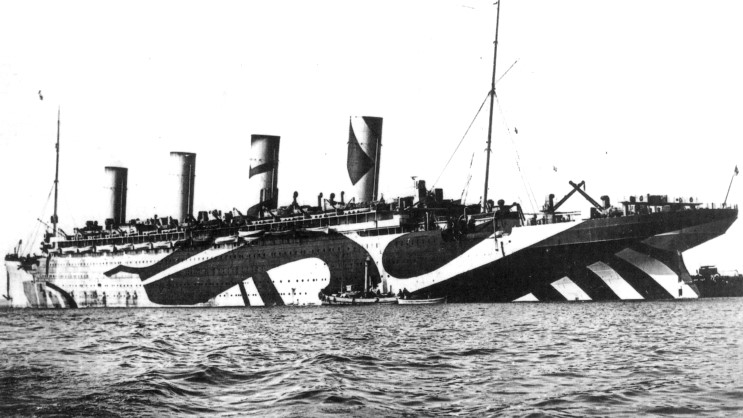
Since the day back in 2008 when et al. sent us Hardy Blechman’s remarkable book Disruptive Pattern Material: An Encyclopedia of Camouflage, OTN has had a lively interest in camouflage and its artistic offspring (you can see OTN's Collected Camo below). And now Tony de Lautour has taken up the hide-me craft and applied it to the odd bunker shape that sits outside the Christchurch Art Gallery. Just what the architects were up to when one of them said, ‘let’s make a square concrete box as an entrance to the car park and stick it right in front of the Gallery’ and the others said, ‘yeah, let’s do that’ we might never know. But now de Lautour’s sly commentary has lifted it into something worth looking at; ain’t art grand? 

LATER: A GREAT COMMENT FROM RALPH PAINE: Gertrude Stein: “I well remember at the beginning of the war being with Picasso on the Boulevard Raspail when the first camouflaged truck passed. It was at night, we had heard of camouflage but we had not seen it and Picasso, amazed, looked at it and then cried out -- Yes it is we who made it, that is Cubism!” Doubtless an epoch-making change in the composition of the world was taking place and Picasso is the first artist to register this fact. Stein goes on even to suggest (perversely?) that the entire First World War had been an exercise in Cubism. And today?

Images: left, dazzle design for a World War I war ship designed to ‘dazzle more to mislead the enemy about a ship's course and so to take up a poor firing position’ and right, Tony de Lautour takes a shot at the car park entrance
 

OTN: the Collected Camo
Ship shape 

Camo site 
War paint
Hidden in plain sight
Camo artists 

A merging artist 
Koons Camo

Thursday, October 30, 2014

Hidden in plain sight

We’ve always had a soft spot for camouflage and OTN has made the camo art link many, many times (you can check out all the camo posts below). But when we entered the Demilitarized Zone between North Korea and South Korea we saw the camo art combo in its full glory and more as art than disguise. It turned out that despite the real tension on the border, most of the military paraphernalia and architecture was in fact a series of elaborate art and architectural metaphors for we-are-more-successful-more-peace-loving-and-all-round-better-human-beings-and-citizens-of-the-world-than-you. A large snazzy railway station in the South zone is poised to send travellers via the Trans-Siberian rail to Europe if only it could. Unfortunately this is not possible without access through the North. A modern cluster of tall apartment buildings you can see in the North was built with no glazing and no residents but as a sign of progress and prosperity. The camouflage too is mostly pure decoration (indeed kind of gaudy) to brighten up playgrounds, entrances to buildings and any spare wall. When you do see a real lookout post painted so that it blends into its environment the effect is very different.

Images: top three show camouflage as decoration and bottom, the real thing at work on the border of North Korea and South Korea

OTN on the camo trail:

All the camo fit to ship
Art camo
Contemporary art camo
Koons and camo
Hidden
Camo heads up
The book that started the whole thing (thanks e)

Wednesday, July 09, 2014

Ship shape

Back in 2008 we were on a camo jag and posted about the Navel boats given the dazzle treatment. This year the Liverpool Biennial, that includes NZ’s Michael Stevenson, has commissioned new treatments of some old ships to commemorate the practice. More here.

Images: Top an original, second row patterning by Carlos Cruz-Diez and bottom how about this from Tobias Rehberger

Wednesday, February 19, 2014

We know a pattern when we see one

Post No. 4 on OTN written back in November 2006 was about a book on camouflage and, loving a theme as we do, over the years we've posted a few camo stories with some connection to art (search camo). Yesterday in the ways of the internet we found a post by Anne Elias (ex Auckland University and now an associate professor in Australia, she has recently written on Peter Peryer’s botanical pics) on how Australian artists did their bit to develop convincing camouflage in WW2. You can only hope it was more convincing than the six billion dollar disaster that has recently seen the digital camouflage developed by the United States military chucked in the trash.

One of the Australian camo practitioners was Max Dupain (best known for his iconic photograph The sun baker) and the other was painter Frank Hinder. Dupain was trained both to recognise camouflaged structures from the air and to use what was called ‘obliterative shading‘ to create his own disguises on the ground. He rather wonderfully described himself as ‘pattern prone.’

Image: Max Dupain’s camouflage experiment at Bankstown aerodrome, c.1943. (Photograph National Archives of Australia)

Wednesday, November 06, 2013

A merging artist

In earlier days OTN was pretty keen on camouflage and its relationship to art. We posted on camouflaging ships and posted some incredibly beautiful pics of painted helmets. It was all kicked off by a book on camouflage that, if it is ever reprinted, should definitely consider adding the Chinese artist Liu Bolin. These photos were taken of a project he did in Venezuela. You can see more here on Artinfo.

Saturday, June 06, 2009

There are three boats hidden in this picture, can you spot them?


We’ve had a few posts on camo particularly on how it has been so wonderfully applied to boats in wartime. This was obviously the inspiration, with a pinch of Roy Lichtenstein, for favourite Jeff Koons when he painted up a pleasure craft for his patron collector Dakis Joannou (he of the red Balloon Dog). The yacht is named Guilty after a Sarah Morris text painting, and its length is 35 metres (114 ft ) for anyone that means anything to.

Wednesday, June 11, 2008

Camo redux


Over the years we have done a couple of posts on camo art, one on a great book called Disruptive Patterns and the other on camo helmets. A reader has now sent us the ultimate shipping-camo art collection post, you can read it here. It probably won’t be too long before airlines start doing their own paint jobs to conceal guilty travellers as they burn up carbon in the sky. Thanks for that B.

Images: Right Cunard poster. Left top USS Leviathan (photo: Jim and Jamie Richter), bottom Russian ship (Photo: John Prolly)

Saturday, November 24, 2007

War paint


About a year ago we pointed readers to the book Disruptive Pattern Material. Since then it has been on almost full-time loan (popular book) so not sure if these stunningly painted First World War German helmets were in it or not. Anyway here they are, some Head Art for a Saturday.

Thursday, November 30, 2006

Pattern recognition

This terrific book, Disruptive Pattern Material: an Encyclopedia of Camouflage, came as a gift from our friends et al. If there is anything that has ever had camouflage on it not represented we can't find it. Essential reading for anyone who likes playing Hide and Seek. One interesting change has been the way the armed forces have turned to digital style camouflage. It seems that the old style was too easily recognised and able to be picked up by electronic scanners - another victory for photography. For an interesting article connecting camouflage with art check out Roy R Behrens on the Tate Gallery site.
ADDITIONAL INFO FROM DM: During WW1, Norman Wilkinson promoted a new camouflage scheme. Instead of trying to conceal the ship, it broke up its lines and made it more difficult for the U-boat captain to determine the ship's course.