Showing posts with label advice to art museum visitors. Show all posts

Thursday, July 14, 2016

The art of art chart art

As part of our admiration for the certainty of Art Charts, we’ve previously posted the famous one by Alfred Barr that fronted the catalogue for MoMA’s groundbreaking exhibition Cubism and Abstract Art in 1936. Many years later the idea showed it had legs when it was provocatively updated. The ‘torpedo’ chart was also a Barr special demonstrating his unwavering faith that the art of the Americas owned the future and that the end of Europe as path-finders was nigh. We also found in MoMA’s archives online Barr’s original sketch for his Abstract art mind-map. All this gives us the opportunity to list two of our favourite art charts that have come our way, a link to others and thank again the people who sent them in.

The art chart thing
Jobs at Te Papa
Touch, don't touch?
How to be an artist
List of past art charts

Friday, June 26, 2015

If you snooze, you lose

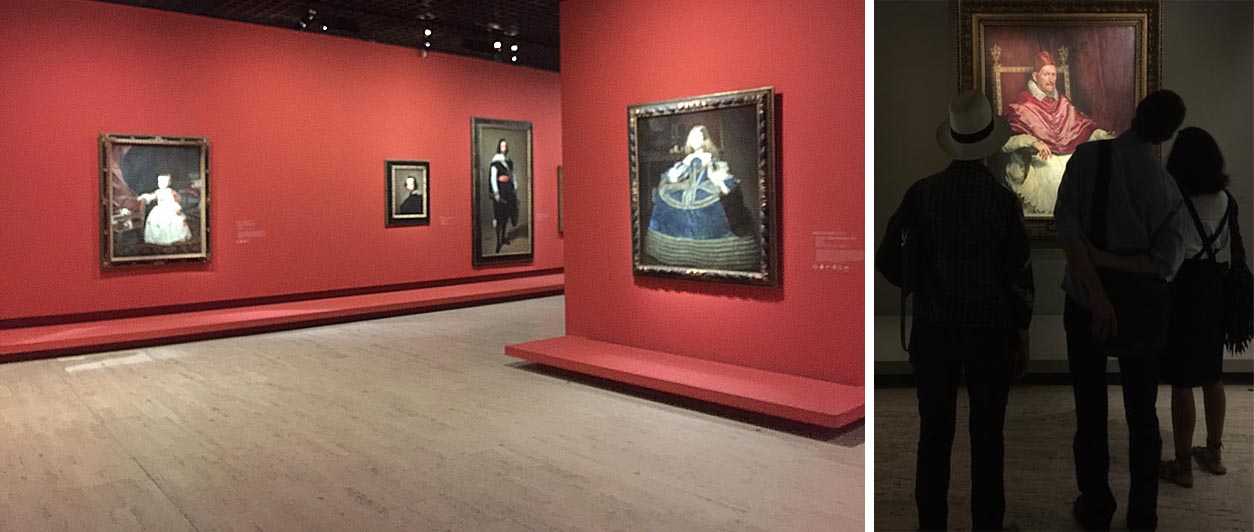
Back in the sixties Georgina Masson came up with some outstanding advice in her classic companion Guide to Rome. When you visit the Vatican head straight for the Sistine Chapel. Her instructions were firm. Do not be diverted, forget the Gallery of Maps, ignore Da Vinci’s St Jerome, and go straight past the Raphael Rooms. We followed her precisely and earned an unimaginable 35 minutes alone with Michelangelo’s famous frescos. We pulled the same stunt today with Velasquez at the Grand Palais in Paris. Timed tickets meant around 200 of us all were let in together but Team V headed for the last three rooms zooming through early works, influences, his time in Venice and even the Rokeby Venus only coming to a standstill in front of the mighty portrait of Pope Innocent X. Francis Bacon might have given it a miss on his trip to Rome, but seriously, it was a mistake. Because of Masson’s advice all those years ago, we had the place to ourselves for half an hour which goes to show that guidebooks can change your life.

We’d like to say we went back to look at the early work at the end of our two hour visit but, between us, we didn’t.

Images: left entering room 11 and right Team V’s private audience with Pope Innocent X

Tuesday, July 22, 2014

Big eyes

After a scan of some dealer galleries, a best-of show in LA and too much time on Google, here’s some of what to expect from art in the next 12 months.
  • Plants in pots, in arrangements and in fragments
  • Large mirrors and reflective surfaces
  • Installations in stand-alone rooms
  • Tiles and more tiles, on the floor, on the wall and on the ceiling
  • Performances (many of them based on work by Yvonne Rainer)
  • Collectives and groups
  • Ceramics, ceramics and more ceramics
  • Rumbling bass sound tracks
  • Small abstract paintings that remind you of other paintings you've seen
  • Artist statements printed onto the gallery wall
  • Things made of bronze that look like they are made of something else
  • Artists writing printed in handouts
  • Artists curating other artists as their own work of art

Saturday, July 06, 2013

Its own reward

One of the great things about art is, that no matter how tired your feet, no matter how many gentlemen's portraits you have seen, or how many miles of corridors you have tramped down there is always the chance that you will round a corner and see a picture of dancing rats.
Image: The dance of the rats by Ferdinand Van Kessell c.1690, Stadel Museum Frankfurt

Wednesday, June 15, 2011

Crowded house

If you want a thoroughly unpleasant experience, you should hot foot it to Manet: Inventor of the Modern at the Musee d’Orsay in Paris. The queues are enormous representing at least two hours of twisting and turning in the huge forecourt of the Museum as you slowly shuffle towards the entrance. But hang on, if you pre-book your tickets you are funnelled into a shorter queue of about ten minutes and that is really not too bad. Until you get into the exhibition that is.

If you had any idea of having a careful look at the paintings, forget it. Even though the tickets are all time specific, crowds are crushed in front of every major work from the moment the doors open. The museum has made the labels for each work very brief and emphasised audio tours and that does nothing to help the flow. If a work is covered in the audio, people show an amazing determination to stop and listen to the whole commentary. Many of them stand stock-still, staring vaguely into the middle distance between them and the work, as they are told stories they assume are about the painting they are hovering in front of (but, given some of the frowns and doubtful head nodding, not always).

However, we did work out a few tricks to at least salvage something out of one of these overcrowded blockbusters.
  • Concentrate on works that are not covered by the audio guide. Most people pass by them quickly looking for the next audio symbol.
  • Head straight to the end of the exhibition and work your way back to the beginning. Most people run out of energy for the last third of the show and the paintings are much easier to see.
  • Learn to enjoy drawings and watercolours and prints. No one else is even vaguely interested.
  • Take photos to remind yourself of what attracted you to the works you liked. There were ‘no photography’ signs everywhere but the guards had given up.
Images: Queuing and viewing.